Between Awareness and Attention

You may have been practising aspects of concentration for years, training your attention on specific objects like your breath, a mantra, or a visualisation, believing this effort represents the pinnacle of spiritual practice. This approach dominates most meditation teachings, which instruct you to direct your attention deliberately toward a chosen target whilst excluding everything else from your field of perception. Attention operates through selection and exclusion, narrowing your consciousness down to a single point or limited field, whilst treating everything outside that focus as a distraction to be ignored or overcome. This concentrated attention requires continuous effort to maintain because it works against the natural tendency of your consciousness to include rather than exclude aspects of life. In many cases, you may find that the harder you try to focus, the more rigid your practice becomes, transforming what should be a natural state into an exercise of mental control.

Awareness functions in a fundamentally different way than most practitioners never discover because they remain fixed in the paradigm of effortful concentration. Awareness is about being open and receptive, naturally including everything that arises within consciousness while still retaining a focus. Awareness is uniquely encompassing, but also focused at the same time. Where attention requires constant maintenance and easily collapses when your willpower weakens, awareness can persist as the natural state of consciousness when you stop trying to control or manipulate your experience. True awareness includes sounds, sensations, thoughts, emotions and perceptions simultaneously. Awareness allows you to hold everything in a spacious field, but to focus on what is important.

Understanding this distinction can change your approach to spiritual practice from doing to being and from achievement to recognition. When you rest in awareness rather than forcing attention, insight can more readily arise from your Life Force Mind.  Awareness also naturally reveals what is present without the distortions introduced by trying too hard to see. Clarity emerges, not through sharper focus, but through the expanded perception that comes when you stop limiting your consciousness to approved objects and instead allow everything to be exactly as it is. Creativity also has the opportunity to flow more freely because you are not constraining your perception but remaining receptive to whatever arises from unexpected directions.

This shift makes spiritual practice less about the discipline of controlling your attention and more about the alignment with your awareness. You stop treating meditation as something you do correctly and instead recognise it as a return to what you are at the core of your being. The irony is profound that the state of consciousness you have been working so hard to achieve through attention has always been available through the awareness you experience when you finally stop trying to attain it. Your task is not to develop more powerful concentration but to recognise the awareness in every moment, with a gentle focus to be who you strive to become.

♾ Awaken your Mind ♾
From Knowing to Being

Your spiritual journey often begins with the accumulation of knowledge, the gathering of concepts and teachings in an attempt to help you understand the nature of reality and consciousness. This process of knowing serves an important function, providing structure and direction as you navigate unfamiliar territory. Yet regardless of how much knowledge you acquire, how many texts you study, or how precisely you can articulate spiritual principles, something essential remains absent until concepts dissolve into lived experience. The transition from knowing to being represents the maturation of genuine spiritual understanding, marking the difference between holding ideas about reality and actually inhabiting that reality moment by moment.

This shift from knowing to being cannot be manufactured through effort or forced through will. It will unfold organically through sustained presence and the gradual recognition that intellectual comprehension, whilst valuable in its place, ultimately points beyond itself to something that can only be known through direct experience. When your awareness rests naturally in being rather than continuously processing experience through conceptual interpretation, you may begin to glimpse life as it is rather than relating to it through the filter of accumulated ideas and beliefs.

In practical terms, this awareness allows you to recognise the subtle difference between talking about presence and actually being present, between holding ideas about consciousness and being consciousness itself. Returning your attention repeatedly to the stillness that exists beneath mental activity helps to anchor your awareness in being rather than in explanation or interpretation. Through this practice, you gradually discover that the truth you have been seeking through the accumulation of knowledge has always been available, requiring not more understanding but rather the willingness to release your attachment to understanding and simply be what you already are.

The journey from knowing to being ultimately reveals that whilst knowledge can point the way, it cannot take you to the destination. Only in the direct experience of existence itself do you discover the living truth that no amount of intellectual comprehension can capture or convey.

♾ Awaken your Mind ♾

Walking on the Light Side

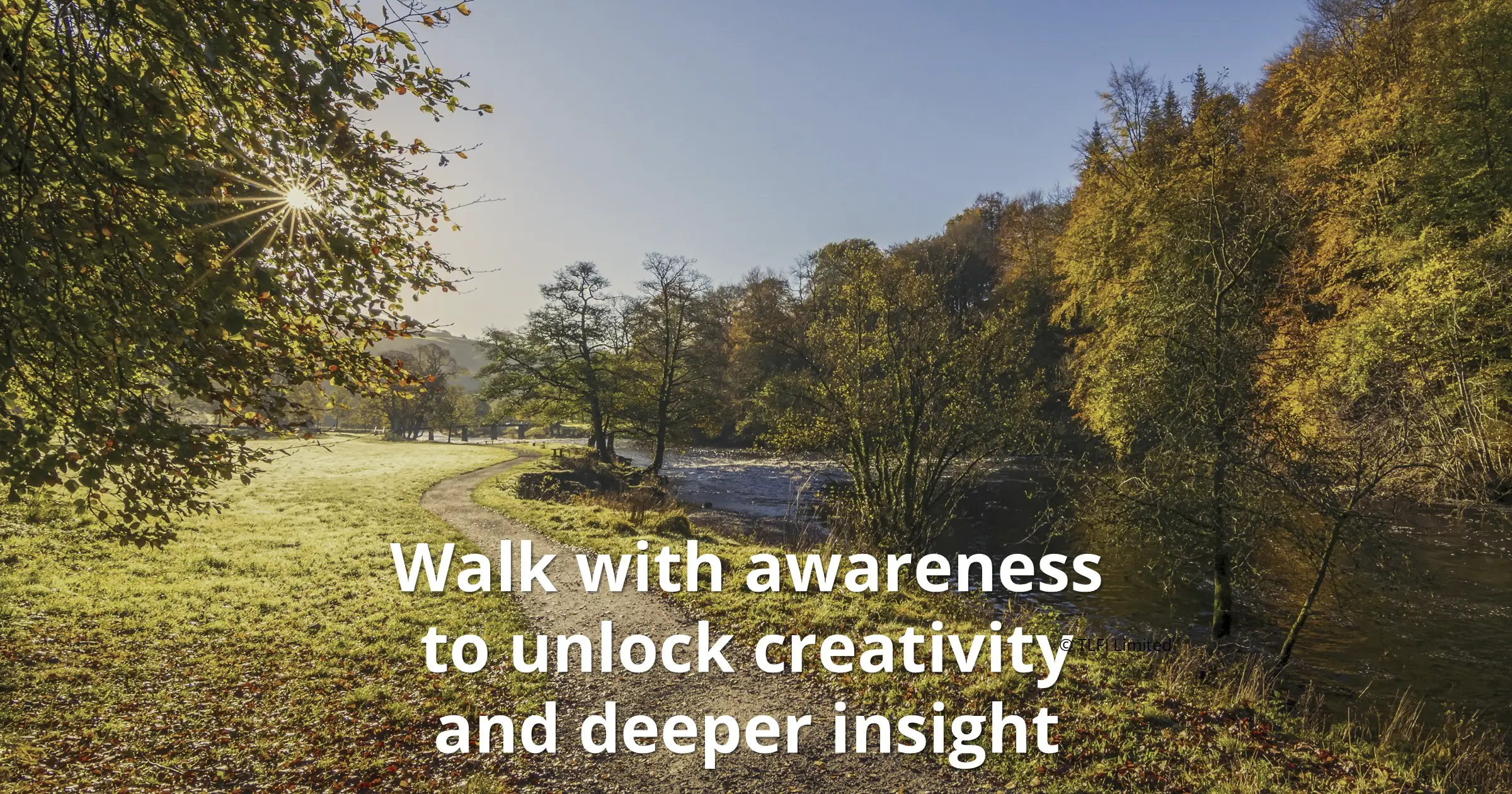
Throughout history, the simple act of walking has served as a gateway to mental clarity. Ancient philosophers developed their most salient ideas whilst pacing along garden paths and spiritual seekers across traditions have recognised what contemporary research now validates.  That being said, placing one foot in front of the other with conscious awareness creates conditions for clarity, creativity and allows the opportunity for understanding to emerge. Walking offers you far more than physical exercise or a practical method of reaching your destination.

The remarkable skill of walking, like speech, represents one of the foundational capacities you mastered during early childhood. What once demanded months of effort and determination and persistent attempts to maintain balance eventually became so automatic that you ceased giving it any conscious attention whatsoever. This extraordinary achievement transformed you into someone capable of exploring your world independently. In the rush of modern existence, many of us have replaced this primal rhythmic movement with mechanical alternatives. Cars, trains, lifts and escalators have replaced a lot of walking in many people’s lives. As a walking creature, designed to move through the world on two feet at a pace that allows engagement with your surroundings, many have lost the connection walking once brought to life.

Scientific investigation provides compelling evidence for why walking enhances both thinking and creative capacity in ways that sitting or standing cannot replicate. Productivity and creative output can increase by approximately sixty per cent when you are walking or have recently completed a walk. This substantial enhancement does not suggest that you should attempt to perform every workplace task whilst strolling about, but it strongly indicates that whenever you seek fresh perspectives, innovative solutions, or breakthrough ideas, incorporating walking into your process will serve you far better than remaining seated and forcing your mind to produce results through sheer effort.

The transformative power of walking emerges partly from how it engages both body and mind in harmonious rhythm, but also in how it can take you out of a situation or enable you to be more mindful.  To access the potential that walking offers, you should approach it with conscious intention rather than treating it merely as a means of reaching somewhere else. Leave your phone behind or keep it silenced and tucked away. Bring awareness to your surroundings rather than moving through familiar territory on automatic pilot, unseeing and unaware. Feel the connection between your feet and the earth beneath you with each step, allow your breath to discover its natural rhythm without forcing or controlling it and permit your mind to properly focus on the present moment. This practice has nothing to do with achieving fitness goals, accumulating step counts, or burning calories. It concerns walking as a contemplative practice, a moving meditation that reconnects you with channels to the deeper knowing that exists within you. Whether you walk through natural settings or city streets, whether for five minutes or an entire hour, each step becomes an opportunity for awareness. 

By reclaiming walking as an awareness opportunity, rather than merely a functional activity for covering distance, you reconnect with your inner self. You are not simply exercising your physical body, but can be awakening your mind, to walking quite literally on the light side, where clarity, creativity and insight naturally flourish with each deliberate step you take.

♾ Awaken your Mind ♾

Expanded States of Consciousness

You may have experienced moments of expanded consciousness during meditation, on retreat, or in spontaneous “peak” experiences where the boundaries of your ordinary awareness suddenly dissolved and you glimpsed something vaster than your usual self. These moments feel extraordinary, yet their true value does not lie in the transcendence itself but in what you do with the insight afterwards. Expanded states of consciousness are not meant to replace your ordinary awareness but to fundamentally inform it, bringing clarity, compassion and coherent understanding into your daily existence; rather than remaining isolated peak experiences you occasionally remember with nostalgia. The real work begins not during the expanded state but in the time that follows, when you must decide whether to integrate what you glimpsed or allow it to fade back into the background noise of your habitual patterns.

When your consciousness expands beyond its ordinary boundaries, your entire perception of reality shifts in ways that initially seem subtle but carry significant implications. Thoughts that once seemed solid and meaningful reveal themselves as transient phenomena arising and dissolving without substance. Emotions transform from overwhelming forces into recognisable patterns of energy moving through you and your sense of identity loosens from the fixed story you have been telling yourself into something far more fluid and spacious. This perceptual shift reduces the psychological friction that makes ordinary life feel like a constant struggle, allowing you to function with greater ease even in complex environments or difficult situations. Your decision-making becomes less reactive and defensive, less driven by concerns of protecting and promoting a small self that you now recognise as partly constructed. Instead, you begin operating from a broader awareness that naturally includes more perspectives, more information and more wisdom than your ordinary consciousness could access.

The challenge is integration, the deliberate practice of anchoring these expanded qualities into your routine life rather than treating them as special states to be achieved only under ideal conditions. Integration begins with noticing the subtle changes that linger after moments of expanded awareness. Are your responses to frustration slightly softer than before? Does your attention hold steady for longer periods without fragmenting? Can you observe your thoughts without immediately believing and following them? These small shifts are not minor improvements but evidence that something fundamental has changed in how you relate to your experience. By consciously bringing these qualities into the mundane aspects that fill your days, you gradually make the expanded state your new mode of functioning rather than an exceptional experience you visit occasionally and then leave behind.

This process transforms spiritual insight from interesting philosophy into embodied wisdom that actually changes how you move through the world. You stop compartmentalising your life into spiritual practice versus everything else, recognising that washing dishes with full awareness contains the same opportunity for expanded consciousness as sitting in meditation if you bring the same quality of attention to it. The ultimate maturity of spiritual practice is not achieving more dramatic experiences, but in actually integrating expanded awareness into ordinary life. This is where transcendence meets immanence, where the extraordinary permeates the ordinary so completely that you stop seeking special states and start recognising the nature of whatever moment you currently inhabit. The consciousness that once seemed expanded becomes your natural way of being and what once felt like effort becomes effortless because you are functioning in alignment with reality, rather than as your conditioning taught you to perceive it.

♾ Awaken your Mind ♾

Love as an Intelligence

Love is frequently misunderstood in our world as mere sentiment or emotional attachment, something that ebbs and flows with your moods and circumstances. True love represents a form of intelligence, an awareness that perceives the interconnectedness of all things and responds with both wisdom and compassion. This intelligent love is dynamic and responsive, liberating in its essence rather than clinging, possessive, or dependent. When you begin to understand love as a form of intelligence rather than simply an emotion, you open yourself to a richer experience than the romantic notions or conditional affections that society often presents as the expression of love.

Becoming aware of your own heart, recognising your fears and understanding your conditioning brings clarity to how love can express itself through you. When your capacity to love becomes informed by presence and conscious awareness, it transforms your relationships. It has the potential to alleviate conflict before it can take root and nurture growth, both within yourself and in those around you. This intelligent form of love respects the autonomy of others whilst simultaneously remaining fully connected to them. You can achieve the delicate balance between discernment and empathy, neither losing yourself in the lives of others nor isolating yourself from meaningful connection. You maintain relationships that respect your authentic self, whilst equally honouring everyone whose life intersects with yours.

Love as intelligence manifests itself through the quality of your daily actions and moment-to-moment choices. It reveals itself when you listen to others without passing judgment, when you offer support without expecting anything in return and when you act with integrity regardless of whether anyone is watching. Each interaction you have with another person becomes an opportunity for refining your heart and expanding your consciousness. When you bring full presence to a conversation, when you extend help without seeking recognition or reward, when you make choices guided by compassion rather than narrow self-interest, you embody this intelligent form of love in tangible ways. Love understood in this way transcends abstract ideals and becomes a living practice, a tangible aspect that harmonises those around you. It provides a foundation upon which you can build truly meaningful connections, resolve conflicts with grace and understanding and contribute to the well-being of those whose lives you touch along your journey.

♾ Awaken your Mind ♾

Fresh Curiosity

Your accumulated knowledge and experience, whilst valuable, can gradually construct invisible barriers that limit your perception of reality. Over time, you develop fixed interpretations of the people you know, the places you frequent and the activities that fill your days. This process of categorisation and assumption serves practical purposes, allowing you to navigate familiar territory with efficiency, yet it simultaneously closes off the possibility of a genuine encounter with what actually exists in this present moment. When you believe you already understand something completely, you cease truly observing it and life becomes a repetition of established patterns rather than a continuous revelation of new possibilities.

The remedy for this gradual dulling of perception lies in recovering what Zen practitioners describe as beginner’s mind, a quality of attention characterised by openness, curiosity and the willingness to meet each experience without the filter of accumulated assumptions. This does not mean abandoning the skills and understanding you have developed through years of learning and practice. Rather, it involves holding your knowledge lightly enough that it does not prevent you from seeing what presents itself in each moment. When you approach your meditation practice as though sitting down for the first time, freed from expectations about what should occur or judgements about how well you are progressing, the practice itself becomes alive rather than mechanical. When you regard someone you have known for years with this same quality of open attention, setting aside your collected stories about who they are and what they will do, you create the possibility of actually seeing the person before you rather than your mental construct of them.

This practice of approaching familiar experiences with fresh curiosity maintains the vitality and depth of your engagement with life itself. Without this quality of attention, your world gradually contracts as everything becomes predictable, understood and therefore unworthy of genuine interest. By deliberately releasing your attachment to knowing and allowing each moment to surprise you, you recover the marvel that transforms ordinary into an extraordinary experience, rich with meaning and possibility. The person you share meals with daily, the route you walk each morning and the practice you have undertaken for years, all contain depths that remain invisible until you bring genuinely fresh eyes to them. If you have a dog and take it for a daily walk and games of ball in the park, have you noticed how each day is always filled with fresh excitement and happiness, learn to take a leaf from their playbook. Such openness to view the world afresh can help to prevent spiritual stagnation, which seems to occur when you assume you have already grasped the full nature of your experience and have nothing new to discover.

♾ Awaken your Mind ♾

What is Happiness Now?

You have been chasing happiness for as long as you can remember, making decisions based on what you believe will bring you joy.  Typically, arranging your life around the pursuit of contentment, yet often happiness itself seems elusive or rapidly vanishes because you are searching for it in the wrong way.

Happiness cannot be found in universal formulas, external achievements, or someone else’s definition of success. What fills one person with happiness or satisfaction leaves another empty and questioning.  Realise that this is not a failure of either person but a fundamental truth about the nature of happiness itself. Your happiness is yours alone, specific to who you are right now in this particular moment of your life and until you grasp this truth, you will continue exhausting yourself trying to feel happy according to standards that were never meant for you. The world sells you images of what happiness should look like, but these images are designed to keep you purchasing the ongoing dream of happiness, striving, but never quite arriving at the promised destination of real happiness.

Most people never realise that happiness is not static but evolves as you evolve through the stages of your existence. The joy you felt as a child playing without responsibility bears little resemblance to the satisfaction you might experience now in your current circumstances. What made you happy five years ago may leave you feeling hollow today, not because something is wrong, but because you or circumstances have changed. Throughout your life, your values shift, your priorities rearrange themselves, your understanding changes and the sources of genuine fulfilment transform accordingly. Yet you may find yourself judging your present happiness against memories of the past, wondering why you cannot recreate those lost feelings; or worse, forcing yourself to pretend you still enjoy things that no longer resonate with who you have become. This backwards-looking comparison creates undue suffering where none needs to exist and blinds you to the happiness which could be available to you right now if you would only recognise it.

When you understand that happiness is both deeply personal and temporally specific, you free yourself from old definitions and begin the real work of discovering what actually brings you happiness now in your life. You need not justify to anyone why a quiet evening alone nourishes you more than social celebrations, why simple presence satisfies you more than elaborate experiences, or why your sources of happiness look nothing like what magazines and social media suggest they should be. Your task is not to achieve some mythical universal happiness, but to know yourself well enough to recognise what genuinely makes you happy right now! This requires self-examination without the distorting lens of what you think should make you happy, what once made you happy, or what makes other people happy. It required that you pay attention to how you actually feel, rather than how you believe you should feel, that you acknowledge your responses rather than perform expected ones and that you permit yourself to find happiness or joy in unexpected places that society might dismiss as insignificant.

Understanding happiness this way transforms it from an external destination you must somehow reach into an internal recognition for you to cultivate. You stop chasing mirages and start noticing the genuine moments of satisfaction that already exist in your life, but that you have been too busy pursuing happiness to actually experience. You stop measuring your happiness against impossible standards and start accepting that your version of happiness is valid precisely because it is yours. This shift does not mean settling for less or abandoning growth, but rather aligning your pursuit of happiness with yourself rather than an imagined ideal. When you define happiness for yourself based on who you are now, you discover something remarkable. You find that happiness was never as far away as you believed, but you were looking for it everywhere except where it actually existed, in the honest recognition of what brings you real joy in this specific moment of your life.

♾ Awaken your Mind ♾

The Power of Mindful Planning

Your mental energy is like currency and you are spending it with every decision you make throughout your day. From the moment you wake, you may be unwittingly drawing from this reserve of cognitive capacity, depleting it with each choice about what to wear, what to eat, which emails to answer first and countless other trivial matters that demand your attention. By the time you finally turn towards what genuinely matters, you may have already diminished much of your decision-making power. This is the hidden cost of an unexamined life and it is sabotaging your potential in ways you may not even recognise.

Mindful planning ahead is not about imposing rigid control over every aspect of your existence or draining the spontaneity from your days. Rather, it is a strategic practice that liberates your mental bandwidth for what is truly important or what matters. When you systematically remove low-value mental noise from your daily equation, you create cognitive space and reserve your energy for important work. You stop haemorrhaging willpower on the mundane and redirect that energy towards innovation, meaningful progress on your goals and the kind of deep thinking that generates breakthrough results. Each small decision which you can hone to a simple and effective choice represents reclaimed mental energy. When you multiply this across dozens of daily choices, then extend it across weeks and months, the cumulative impact becomes substantial. You discover sharper focus, enhanced creativity, greater stamina and improved concentration.

Effective planning, however, demands genuine self-awareness. Your mental energy is not constant but fluctuates significantly throughout each day and varies across the week according to patterns which you can learn to recognise. Appropriate planning means understanding these natural rhythms and working in harmony with them rather than against them. When you understand your natural energy periods, you can choose a time which requires your sharpest thinking, strongest willpower and most creative capacity. This conscious resource allocation is not merely about productivity in the conventional sense but about honouring the reality of your human limitations whilst maximising your potential within them.

When you plan with true intention, you are making a fundamental choice about how you want to engage with your life and where you will direct your finite attention. You are acknowledging that your mental energy is a valuable resource which should not be squandered on decisions that warrant none of it. You are refusing to live reactively, lurching from one demand to the next and instead creating the conditions for your best thinking or your most meaningful work. This is how you honour your potential, rather than surviving whatever demands each day presents. The question is not whether you have enough mental energy to accomplish what matters most, but whether you are consciously directing that energy towards what is important, rather than allowing it to drain away through thousands of thoughtless choices.

♾ Awaken your Mind ♾