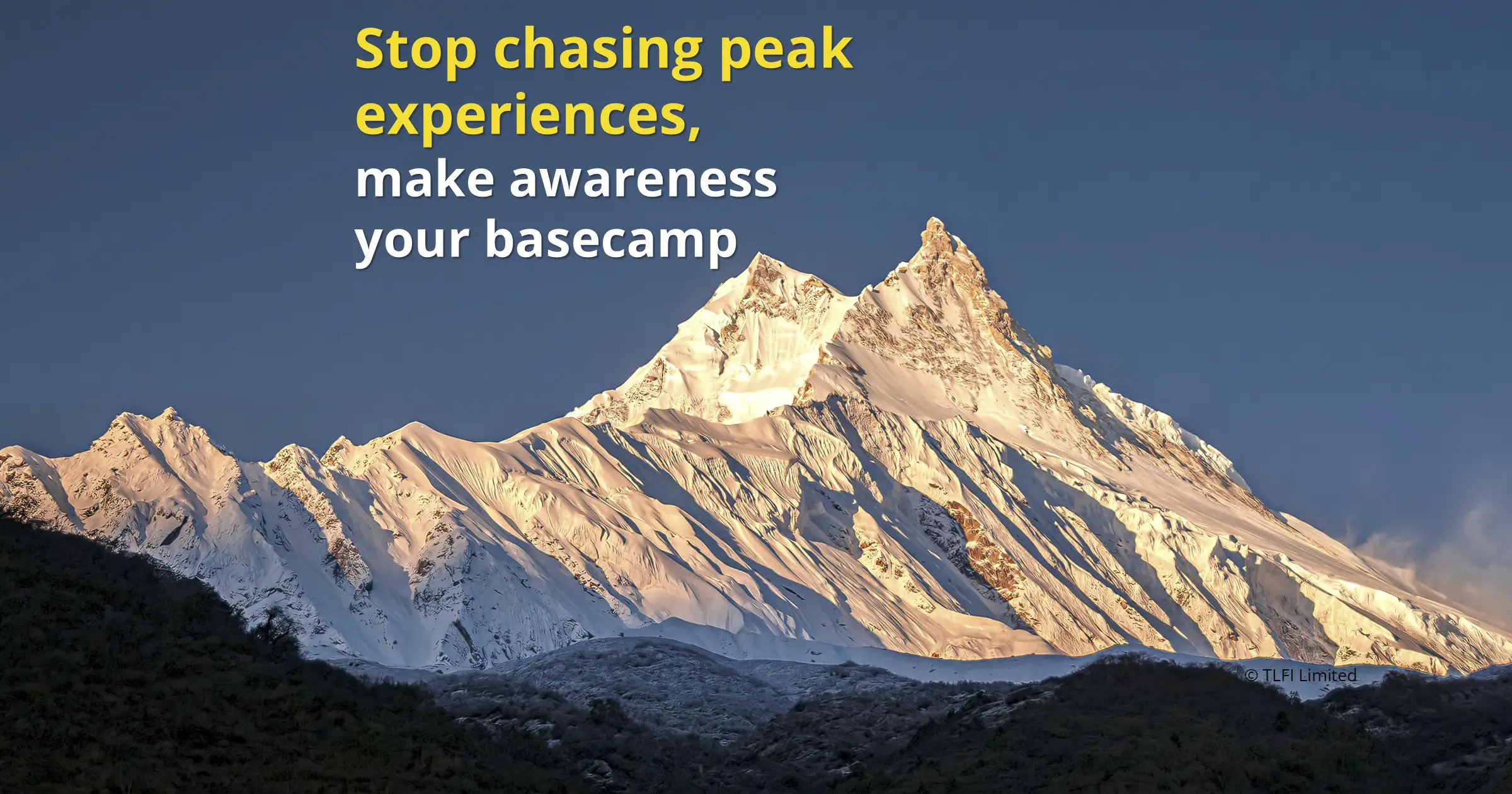
You may have experienced moments of expanded consciousness during meditation, on retreat, or in spontaneous “peak” experiences where the boundaries of your ordinary awareness suddenly dissolved and you glimpsed something vaster than your usual self. These moments feel extraordinary, yet their true value does not lie in the transcendence itself but in what you do with the insight afterwards. Expanded states of consciousness are not meant to replace your ordinary awareness but to fundamentally inform it, bringing clarity, compassion and coherent understanding into your daily existence; rather than remaining isolated peak experiences you occasionally remember with nostalgia. The real work begins not during the expanded state but in the time that follows, when you must decide whether to integrate what you glimpsed or allow it to fade back into the background noise of your habitual patterns.
When your consciousness expands beyond its ordinary boundaries, your entire perception of reality shifts in ways that initially seem subtle but carry significant implications. Thoughts that once seemed solid and meaningful reveal themselves as transient phenomena arising and dissolving without substance. Emotions transform from overwhelming forces into recognisable patterns of energy moving through you and your sense of identity loosens from the fixed story you have been telling yourself into something far more fluid and spacious. This perceptual shift reduces the psychological friction that makes ordinary life feel like a constant struggle, allowing you to function with greater ease even in complex environments or difficult situations. Your decision-making becomes less reactive and defensive, less driven by concerns of protecting and promoting a small self that you now recognise as partly constructed. Instead, you begin operating from a broader awareness that naturally includes more perspectives, more information and more wisdom than your ordinary consciousness could access.
The challenge is integration, the deliberate practice of anchoring these expanded qualities into your routine life rather than treating them as special states to be achieved only under ideal conditions. Integration begins with noticing the subtle changes that linger after moments of expanded awareness. Are your responses to frustration slightly softer than before? Does your attention hold steady for longer periods without fragmenting? Can you observe your thoughts without immediately believing and following them? These small shifts are not minor improvements but evidence that something fundamental has changed in how you relate to your experience. By consciously bringing these qualities into the mundane aspects that fill your days, you gradually make the expanded state your new mode of functioning rather than an exceptional experience you visit occasionally and then leave behind.
This process transforms spiritual insight from interesting philosophy into embodied wisdom that actually changes how you move through the world. You stop compartmentalising your life into spiritual practice versus everything else, recognising that washing dishes with full awareness contains the same opportunity for expanded consciousness as sitting in meditation if you bring the same quality of attention to it. The ultimate maturity of spiritual practice is not achieving more dramatic experiences, but in actually integrating expanded awareness into ordinary life. This is where transcendence meets immanence, where the extraordinary permeates the ordinary so completely that you stop seeking special states and start recognising the nature of whatever moment you currently inhabit. The consciousness that once seemed expanded becomes your natural way of being and what once felt like effort becomes effortless because you are functioning in alignment with reality, rather than as your conditioning taught you to perceive it.
♾ Awaken your Mind ♾