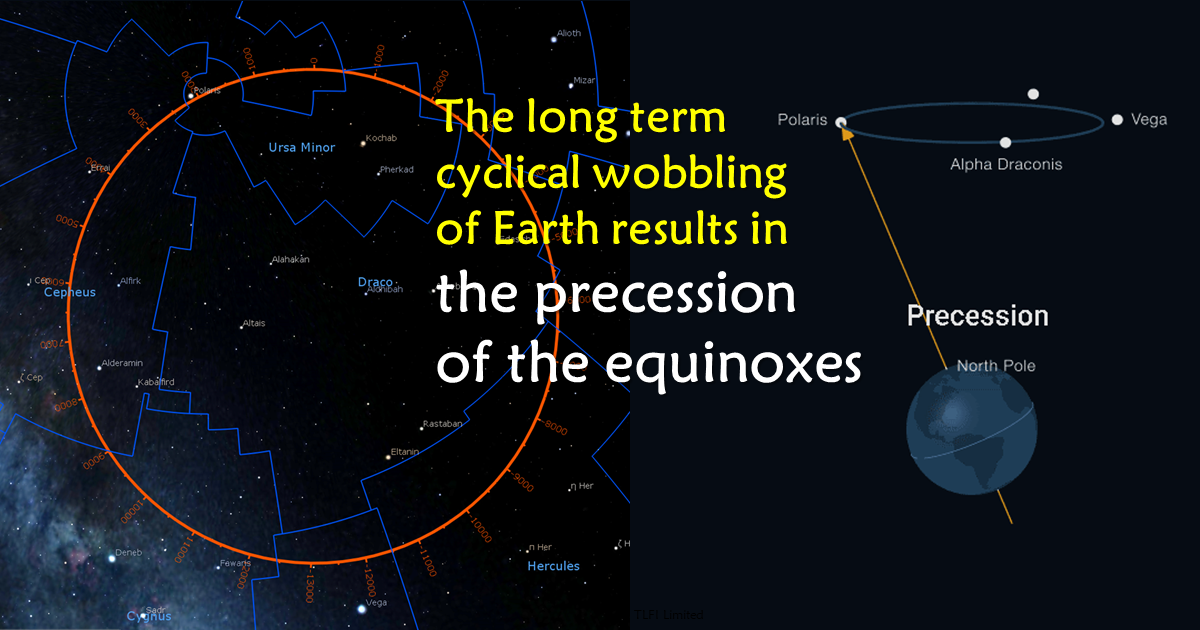
This phenomenon of the precession of the equinoxes is due to the long term cyclic wobbling in the orientation of Earth’s axis of rotation. This wobble of 1 degree for every 71.6 years was identified by Sir Isaac Newton and has since been better quantified as we have learnt more about the mechanics of the Solar System. We now know that the precession is caused by the gravitational effects of both the Sun and the Moon coupled with the fact that our planet is not a perfect sphere. Consider that the Earth is tilted and that the Sun’s gravitational pull is stronger on the portion that is tilted towards it, thus creating a torque effect on the planet. This torque coupled with the gravitational effects of the moon, which is tilted out of the plane by five degrees, causes the slow but very gradual wobble of the Earth.
The precession of the Earth’s axis has several noticeable effects. The first noticeable effect of this is that the positions of the north and south celestial poles appear to move in circles. The celestial poles take 25,772 years to create a full circle against the backdrop of seemingly fixed stars. Today, the star Polaris lies approximately at the north celestial pole, this will change over time as other stars become the north star. Second, the precession of the equinoxes moves slowly westwards across the sky, causing a drift in the observed position of the astronomical constellations. What this means is that each astrological star sign now contains the constellation that was formerly to the east. As an example, the tropical astrological star sign of Capricorn now covers a sector of the sky which is filled with the astronomical constellation of Sagittarius.
The location of the vernal equinox has shifted approximately 23 degrees westward over the past 2,000 years, will continue to progress westward at approximately 50.3 arc-seconds each year. When the astronomer Ptolemy mapped 48 constellations in the second century, the vernal equinox occurred in the constellation of Aries. Now due to the continued process of precession, the location of this equinox has shifted westward so that the vernal equinox now appears in the constellation of Pisces. This can be proven by simple observation of the night sky or the use of various apps on your smartphone which can map the stars.
The precession of the equinoxes is the prime reason for the difference between the true astronomical positions of the constellations and (western or tropical) astrology. Astronomical Astrology aligns with the science of astronomy and the real observations of the Sun, Moon and planets across the sky by factoring in the precession of the equinoxes.
♾ Awaken your Mind ♾